%%html
<script src="https://bits.csb.pitt.edu/preamble.js"></script>

AlphaFold Key Takeaways
Evolution provides structural information. Templates provide known geometry; coevolving residues suggest interactions.
AlphaFold2 integrates sequence, evolutionary, and geometric information. The Evoformer updates MSA and pair features; the structure module updates residue frames.
Geometry matters in both the architecture and the loss. IPA uses spatial relationships; FAPE compares positions in residue-local frames.
Assess local accuracy and global arrangement separately. pLDDT estimates local accuracy; PAE assesses confidence in relative placement; pTM is overall structure.
Structure prediction is not a simulation of protein folding. A predicted structure does not reveal folding pathways or conformational populations.
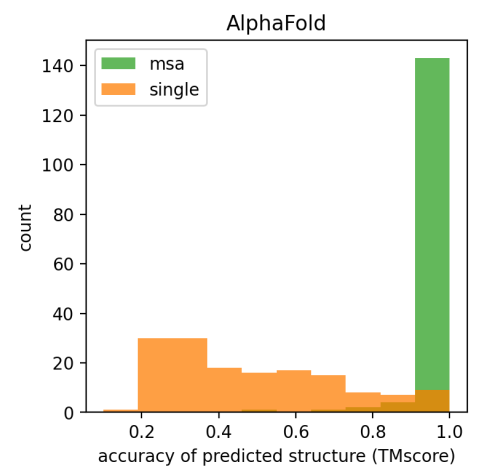
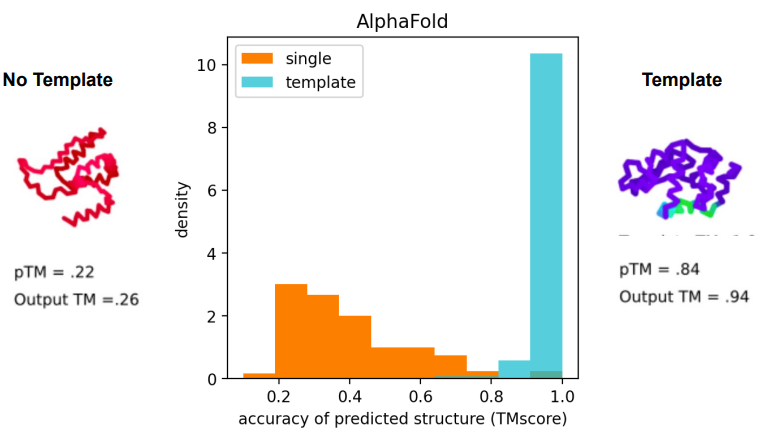
How Important is the MSA?

Neff = normalized nonredundant sequences
Coverage = how much of the target does this template provide structural information for?
AF2Rank
Providing a single sequence and candidate structure let's us repurpose AF2 as a structure evaluator instead of generator.
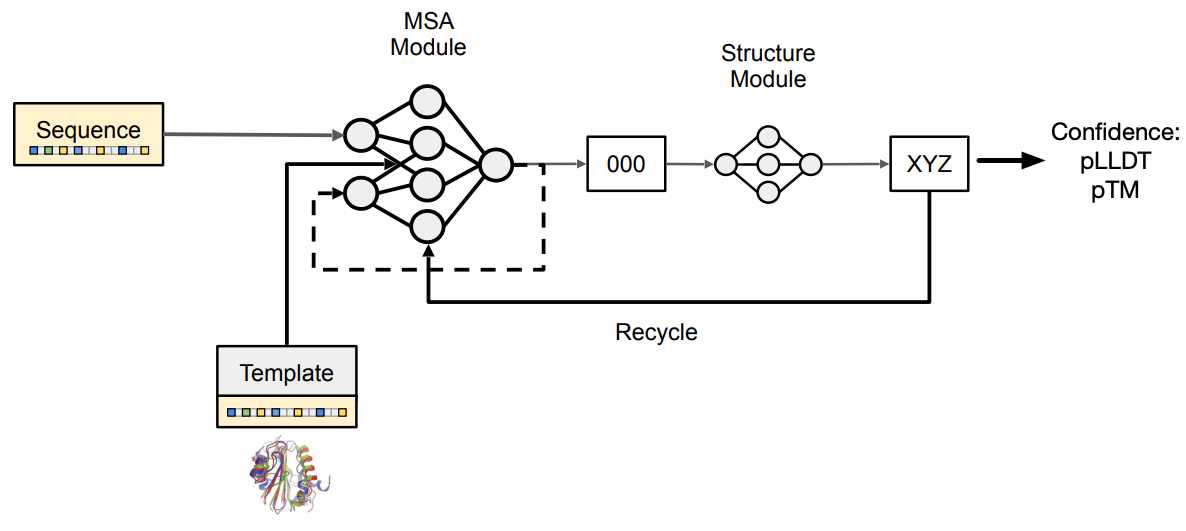
Image credit: S. Ovchinnikov
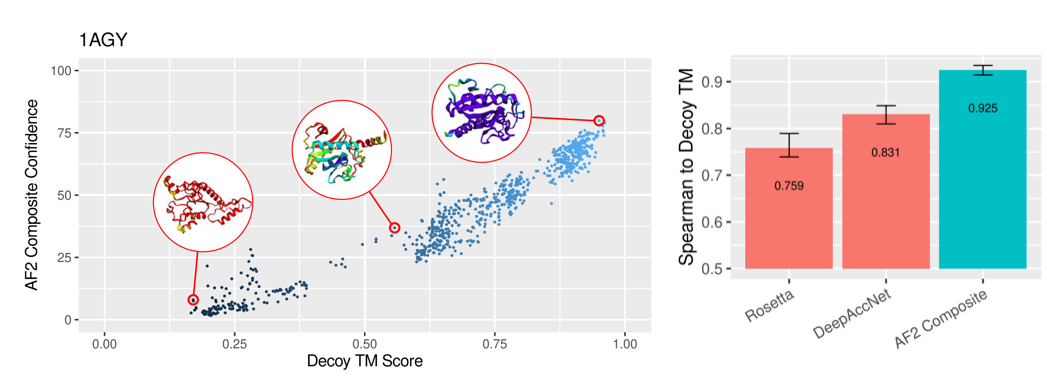
AF2Rank
AlphaFold's confidence in its prediction correlates with the quality of the input template (single sequence case). This ranking of structures outperforms the previous state-of-the-art scoring.
A proposed role for the MSA

The MSA may guide search; learned structural preferences help refine candidates.
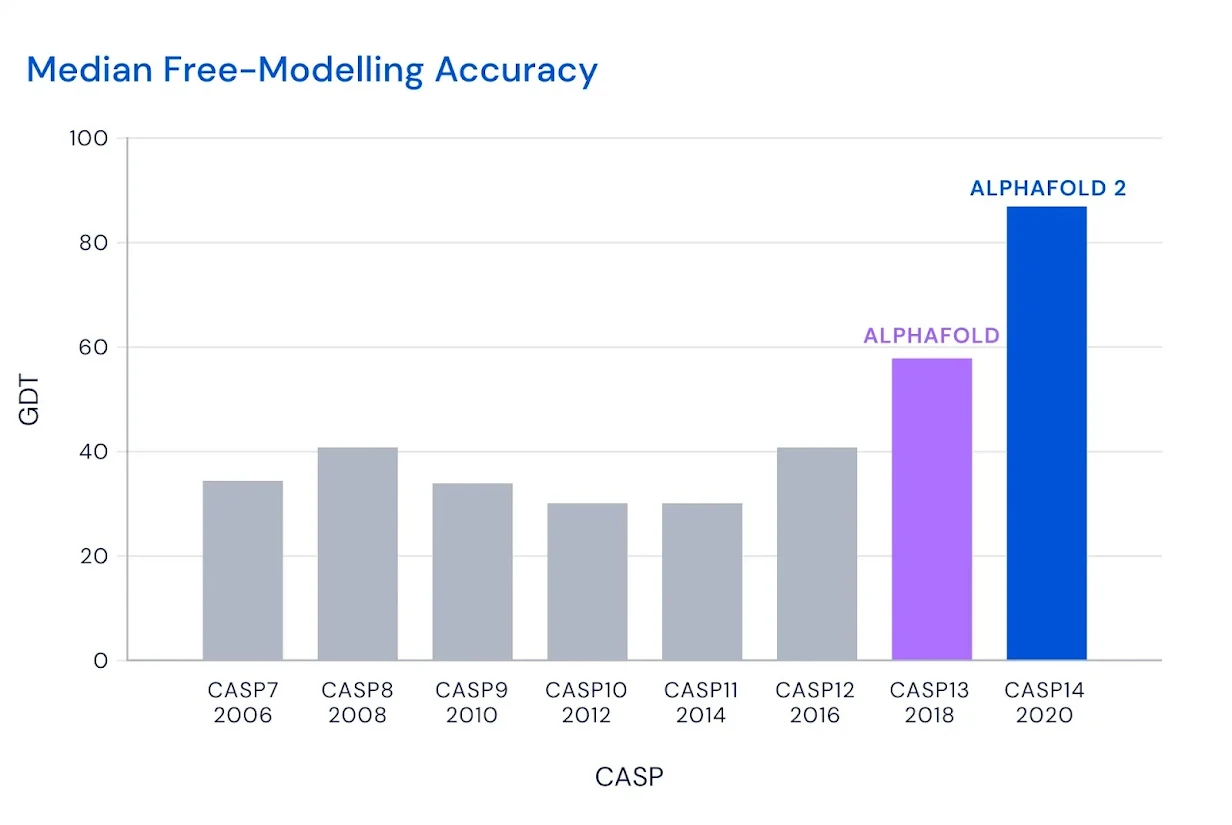
AlphaFold Multimer
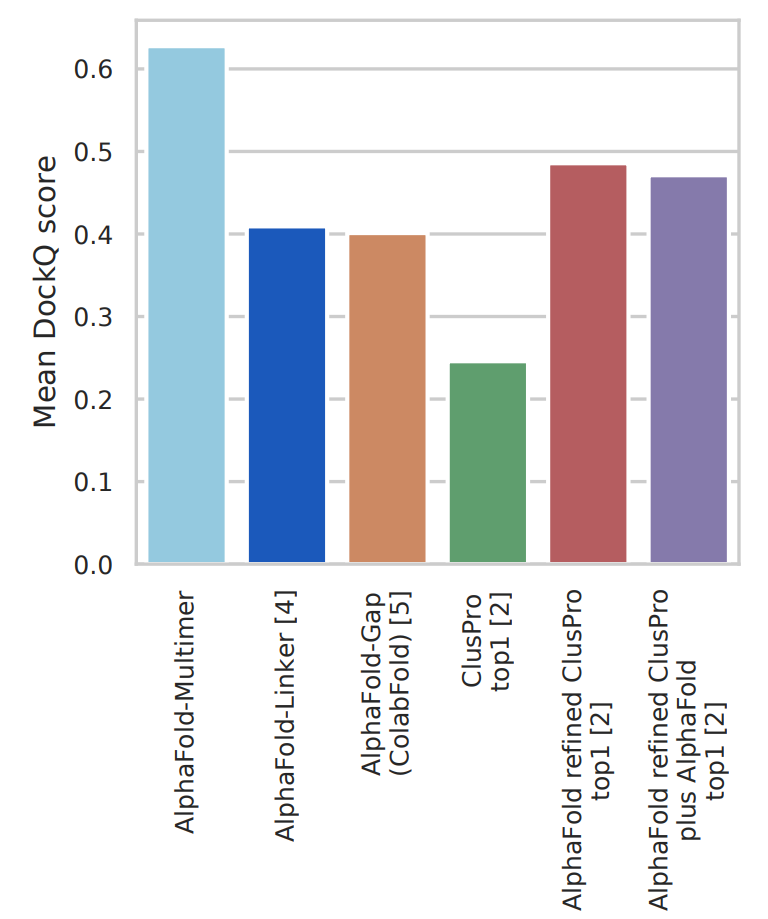
AF2 architecture retained: Evoformer, structure module, and recycling; all chains are predicted jointly from their sequences and specified stoichiometry.
Trained on complexes: Uses multichain biological assemblies, with training crops that include interacting regions from different chains.
Explicit chain identity: Distinguishes residues within a chain, across chains, and in identical copies of a protein.
Losses adapted to interfaces: Uses a larger interchain FAPE cutoff (30 Å versus 10 Å within chains), along with adjustments to clash and chain-placement penalties.
Paired and unpaired MSAs: Combines each chain’s evolutionary information with homologs paired across species to reveal potential interchain coevolution.
Sample the MSA. Data augmentation and balancing. Chain with many homologs dos not dominate.
Interface confidence: Introduces ipTM to assess interchain arrangement.
Alphafold Multimer
Pair homologs across chains
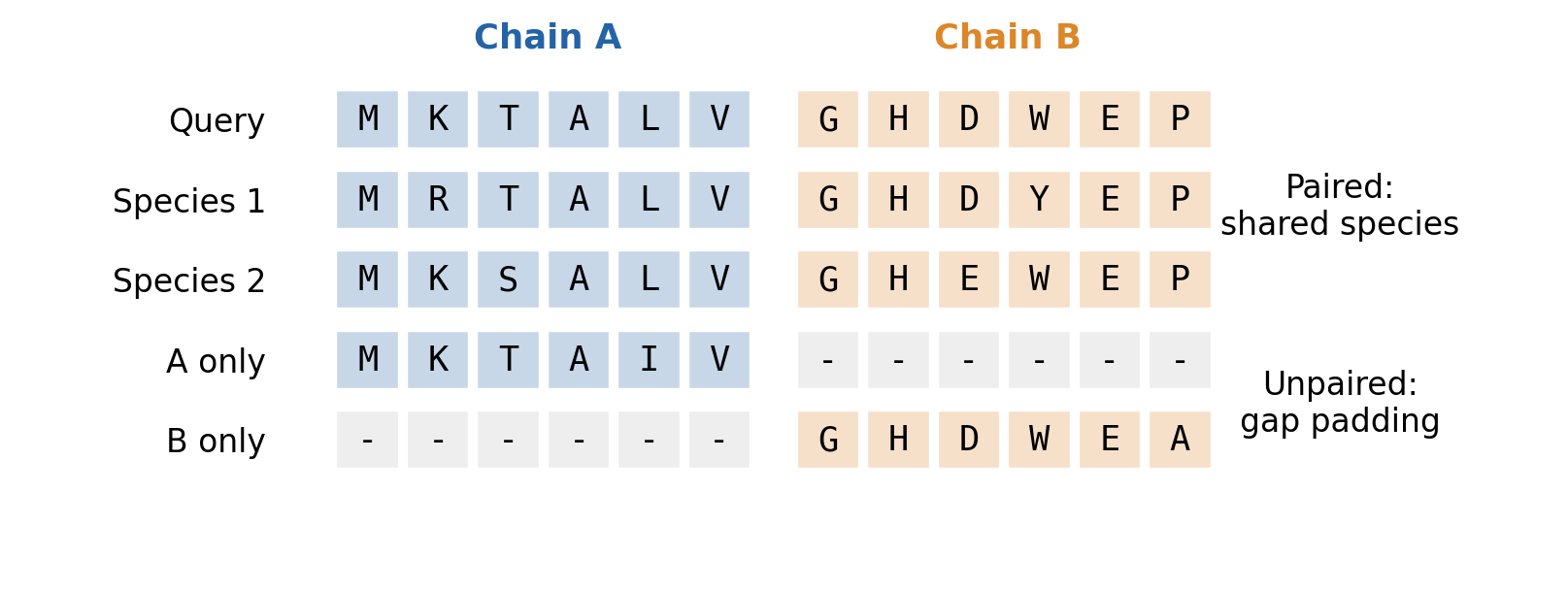
Paired rows can expose cross-chain coevolution. Paralogs complicate pairing.
Read the inter-chain PAE blocks
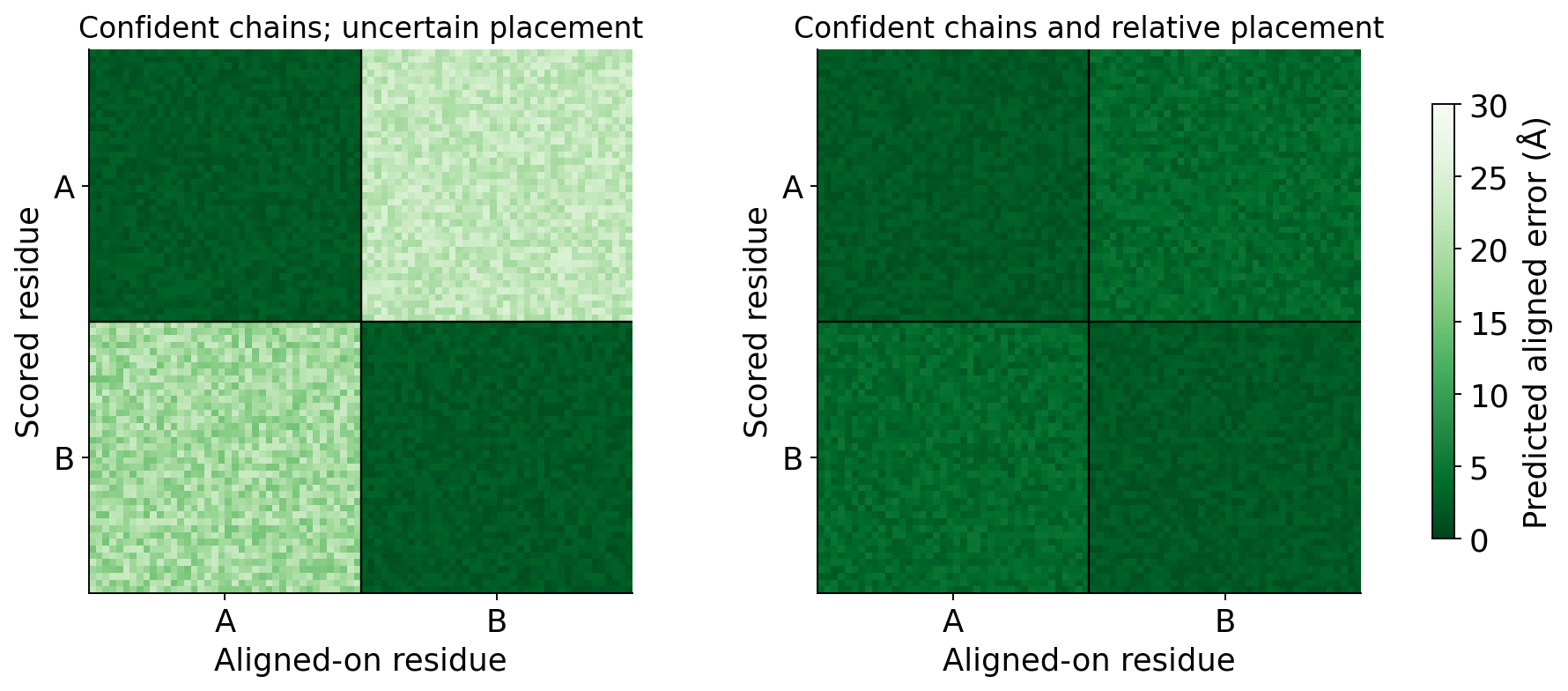
Good individual chains can still have an uncertain relative placement.
Synthetic teaching example. Darker green = lower PAE.
ipTM
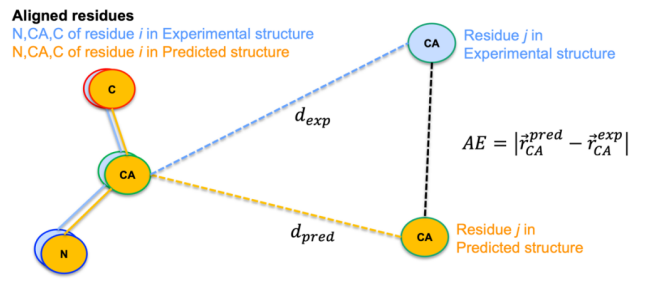
ipTM (interface predicted TM-score) measures confidence in the relative placement of chains. Basically cross-chain pTM.
The problem: a confident interface can have low ipTM when long disordered tails or noninteracting domains have uncertain positions.
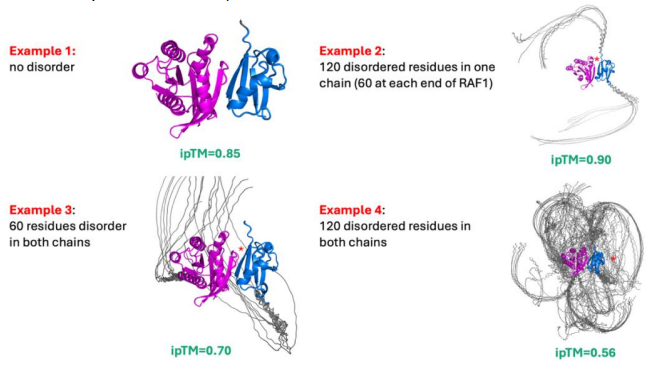
ipSAE (interaction prediction Score from Aligned Errors) focuses the score on confidently positioned regions.
Dunbrack, R. L., Jr. (2025). Rēs ipSAE loquuntur: What’s wrong with AlphaFold’s ipTM score and how to fix it. bioRxiv.Conformational Sampling with AlphaFold
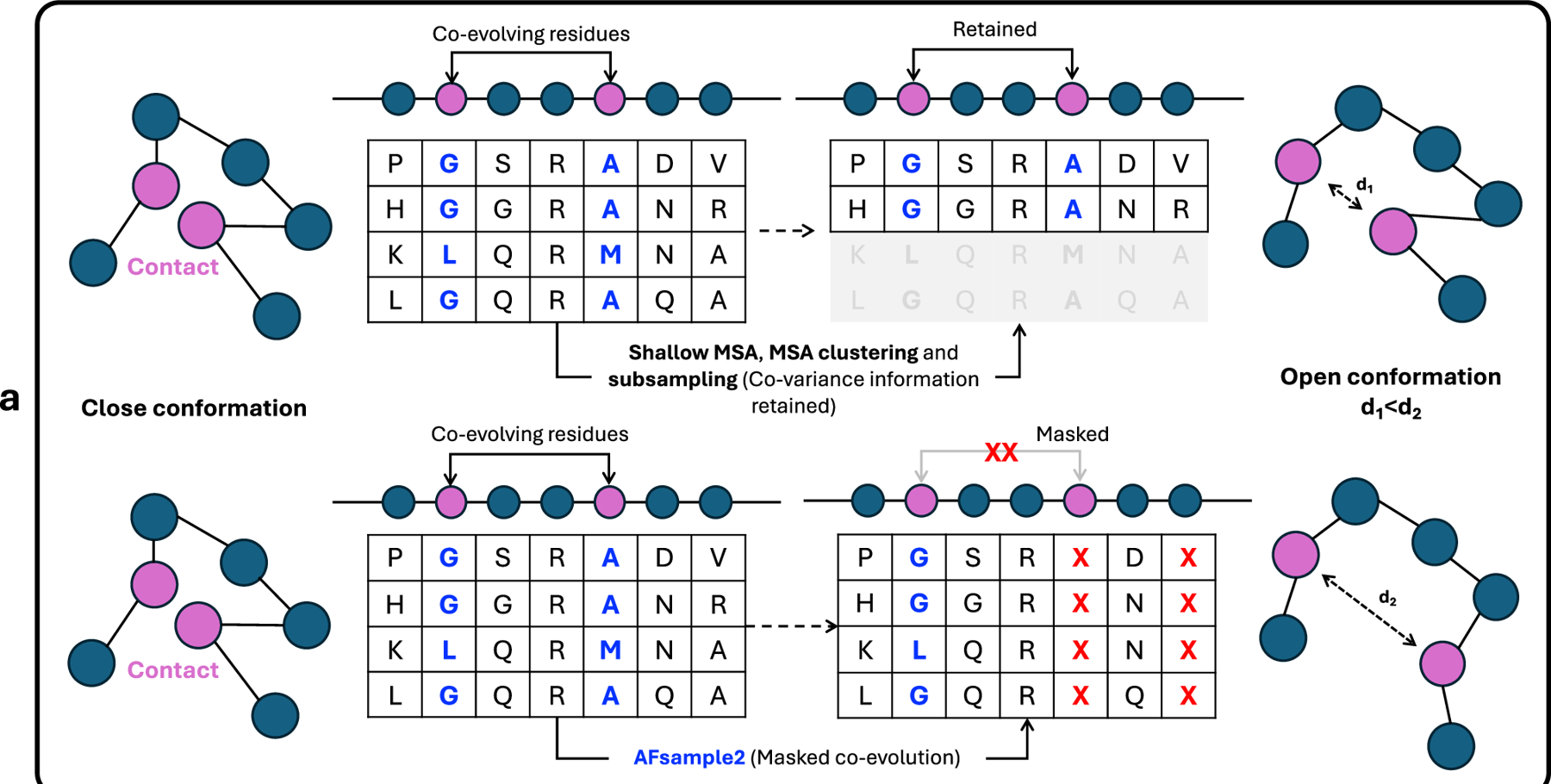
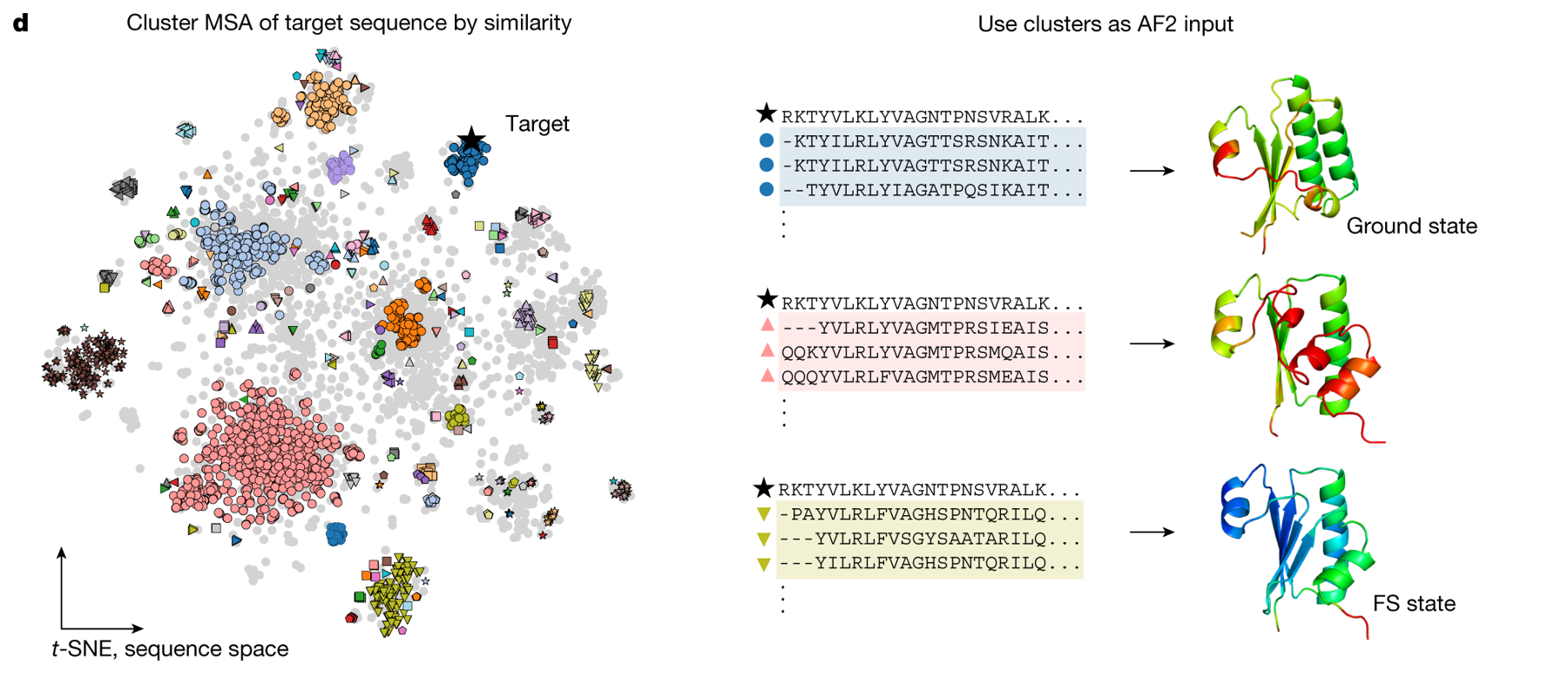
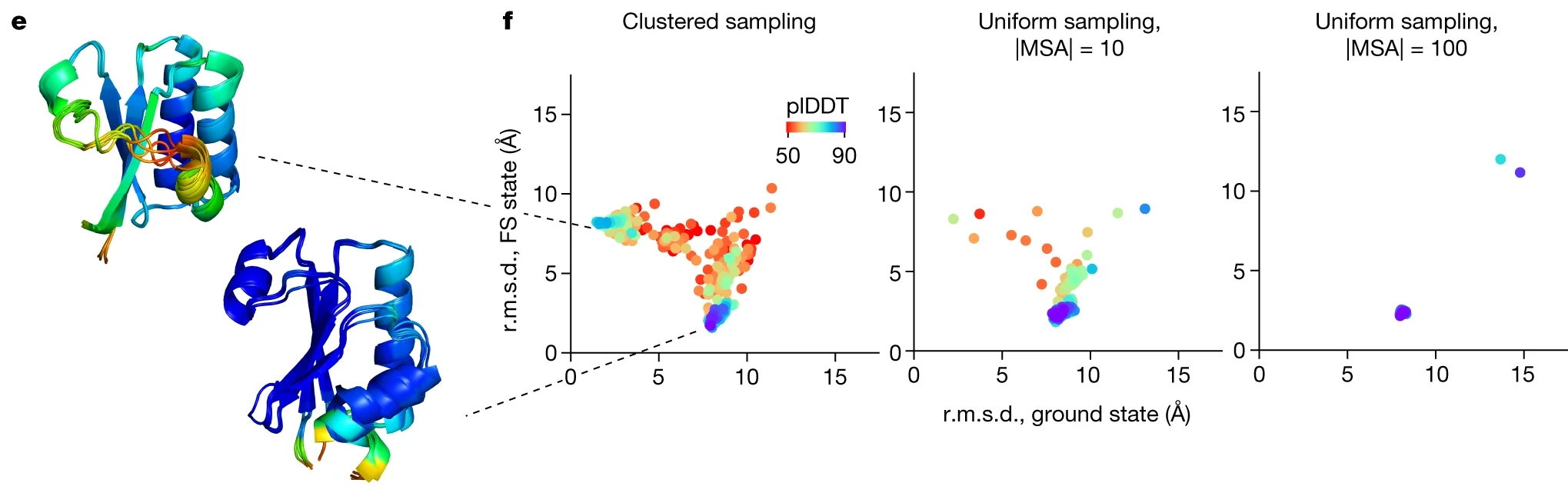
Change the evolutionary evidence supplied to AF2 while keeping its trained weights fixed.
| Approach | What changes? | Example |
|---|---|---|
| Random subsampling | Use shallow MSAs containing different random subsets of homologs | del Alamo et al. |
| Sequence clustering | Group similar homologs and predict separately with each cluster’s MSA | AF-Cluster |
| Targeted MSA edits | Replace selected alignment columns with alanine, targeting contacts identified in an initial structure | SPEACH_AF |
Different subsets or edits can shift predictions toward alternative conformations.
Greater diversity can also include misfolded structures. Prediction frequencies are not automatically equilibrium populations.
Wayment-Steele et al. (2024). Predicting multiple conformations via sequence clustering and AlphaFold2. Nature.
Stein & Mchaourab (2022). SPEACH_AF: Sampling protein ensembles and conformational heterogeneity with Alphafold2. PLOS Computational Biology.
Shallow MSAs can reveal other states
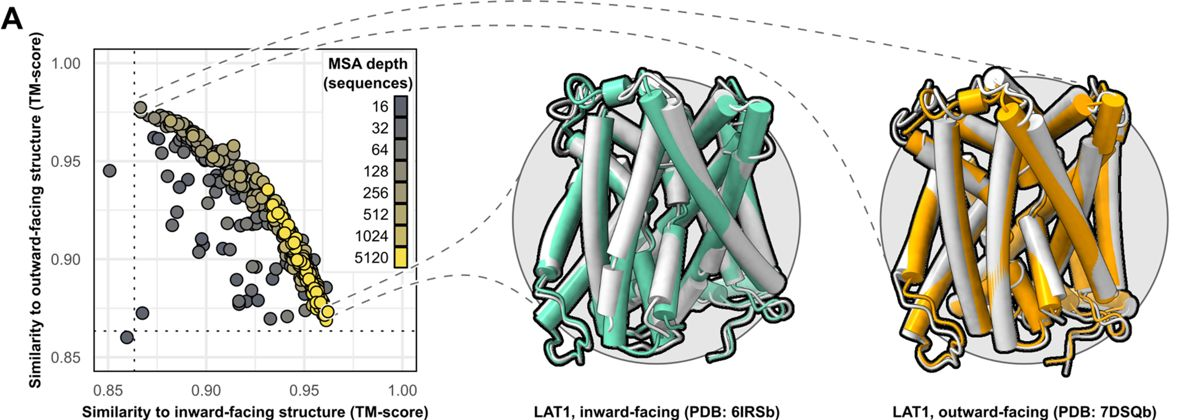
LAT1: compare predictions with inward- and outward-facing structures.
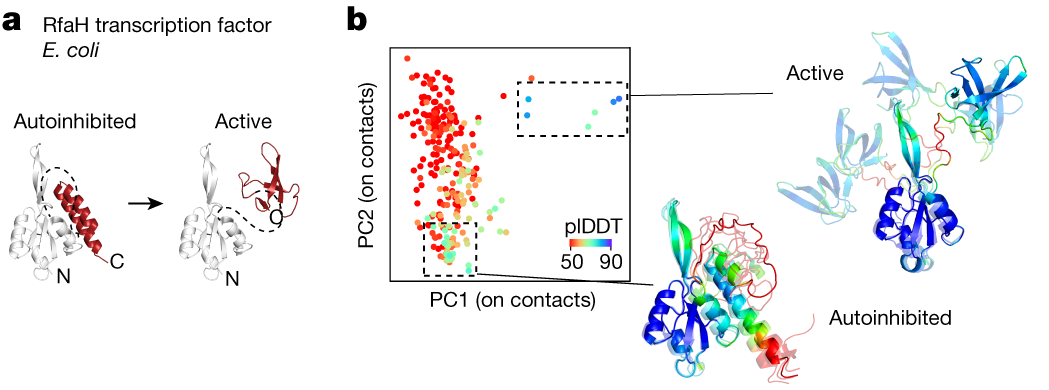
Unseen fold switches remain difficult
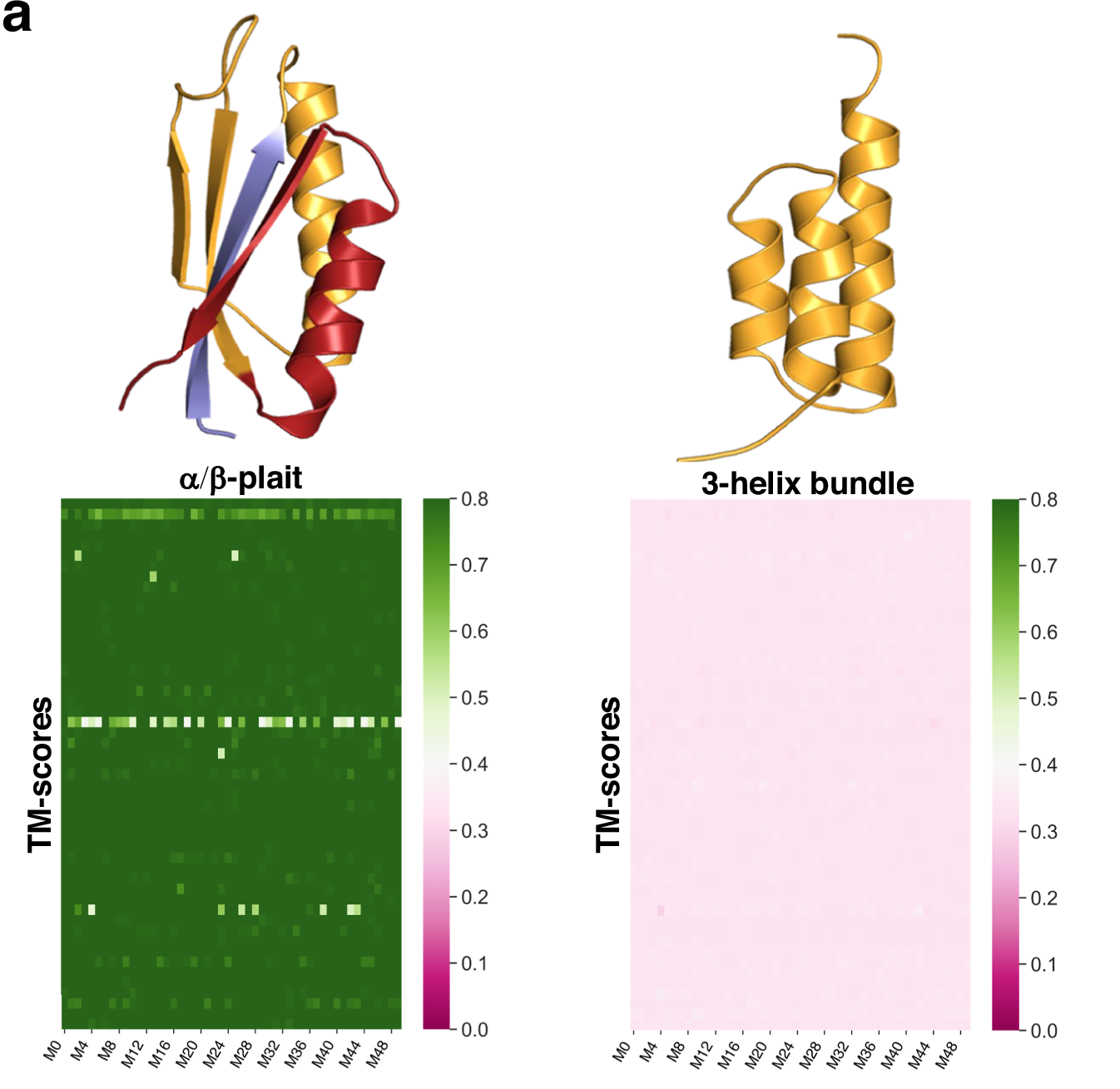
A separate held-out set: only 1 of 7 switches recovered.
Sa1 predictions recover the α/β fold and miss the three-helix bundle.
Chakravarty et al. (2024). AlphaFold predictions of fold-switched conformations are driven by structure memorization. Nature Communications 15, 7296.
Case study: prospective ligand discovery
Question: can unrefined AF2 receptor models support discovery of new ligands?
Lyu et al. docked the same large libraries against AF2 and experimental receptor structures, then tested selected compounds.
| Target | AF2 hits / tested | Experimental-structure hits / tested |
|---|---|---|
| σ₂ receptor | 64/119 (54%) | 70/138 (51%) |
| 5-HT₂A receptor | 42/161 (26%) | 51/223 (23%) |
Hits: >50% radioligand displacement at 1 μM (σ₂) or 10 μM (5-HT₂A). Rates concern selected compounds, not the full library.
A discovered ligand gets a structural test
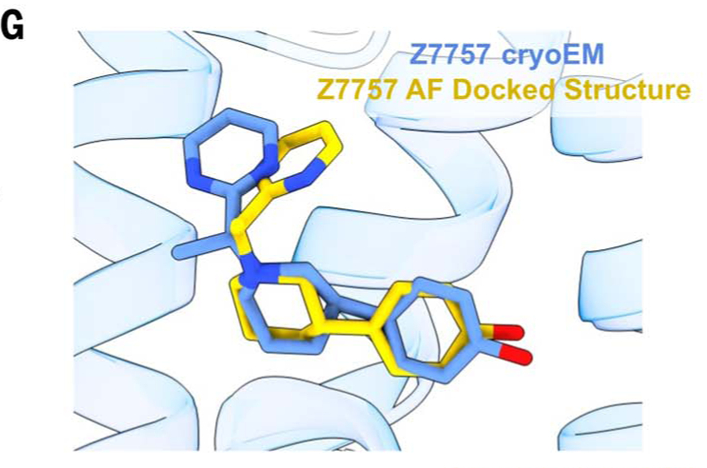
Cryo-EM of the new 5-HT₂A agonist Z7757 supports the predicted binding pose.
AF3 - a focus on the pair representation
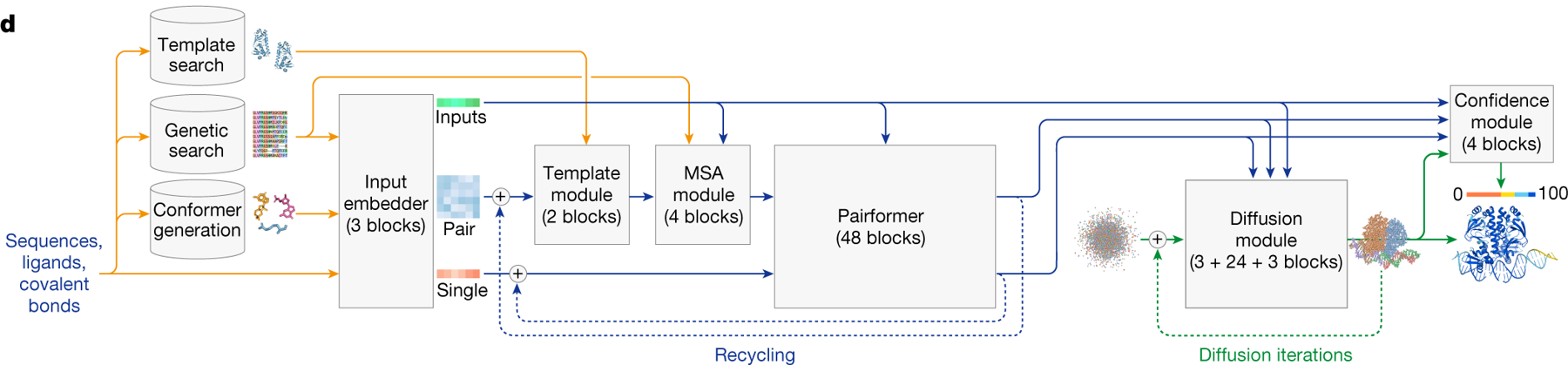
Molecular inputs → learned representations → coordinate diffusion.
AF2 → AF3: what changes?
| AF2 | AF3 | |
|---|---|---|
| Representation trunk | Evoformer: MSA + pairs | Short MSA processing + Pairformer |
| Coordinate output | Residue frames and torsions | Atomic coordinates |
| Structure generation | Structure-module refinement | Repeated denoising |
AF3 retains evolutionary input and triangle-based pair reasoning.

AF3’s coordinate denoiser

Atom/token attention; random rotations and translations; no hard-coded rotational equivariance.
Diffusion training: corrupt coordinates
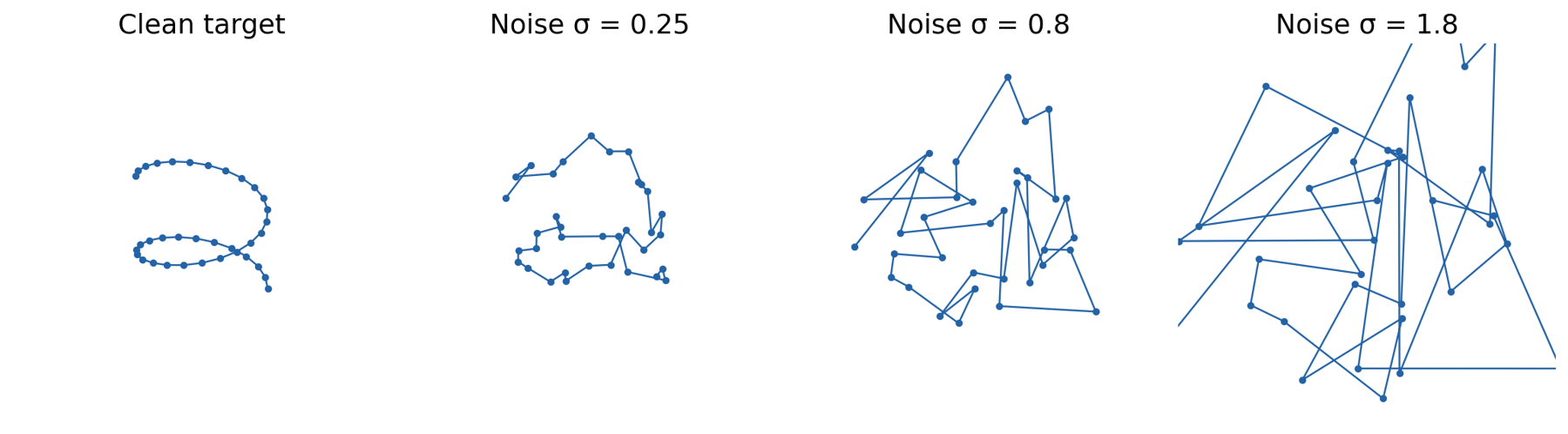
$$\mathbf{x}_{\sigma}=\mathbf{x}_0+\sigma\boldsymbol\epsilon,\qquad\boldsymbol\epsilon\sim\mathcal N(0,I)$$
The input includes the noise level and molecular context.
Diffusion: learn to denoise, then generate
The idea: learn to recover clean data from noisy examples, then use that to generate new samples.
Training: the correct structure is known
$$ \underbrace{\mathbf{x}_{\sigma}=\mathbf{x}_0+\sigma\boldsymbol{\epsilon}}_{\text{add Gaussian noise}} \quad\xrightarrow{\;D_\theta(\mathbf{x}_{\sigma},\,\sigma,\,c)\;} \underbrace{\widehat{\mathbf{x}}_0}_{\text{predict clean coordinates}} $$
- Train at many noise levels $\sigma$, comparing predictions with the known coordinates $\mathbf{x}_0$.
- The denoiser $D_\theta(\mathbf{x}_{\sigma},\,\sigma,\,c)$ receives both the noise level and conditioning information $c$.
Generation: start from random coordinates
- Predict clean coordinates using the trained denoiser.
- Take a step toward that prediction and reduce the noise level.
- Repeat: large-scale arrangement → local atomic geometry.
In AF3: $\mathbf{x}$ contains atom coordinates; $c$ includes molecular identities and Pairformer features. These guide every denoising step.
Different random starts can produce different candidate structures.
Abramson et al. (2024). Accurate structure prediction of biomolecular interactions with AlphaFold 3. Nature 630, 493–500.
Diffusion does not guarantee state coverage

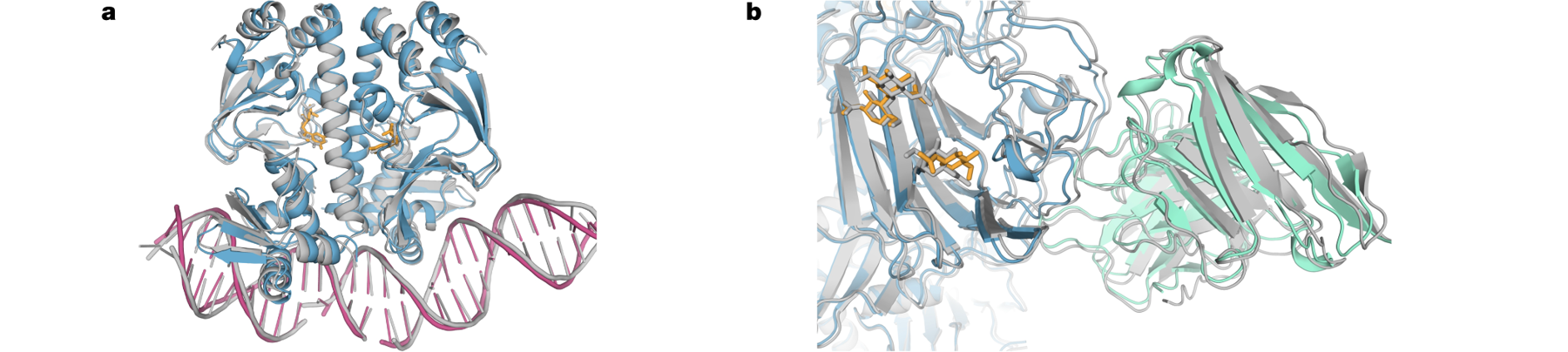
AF3 predicts closed conformations in both apo and holo conditions. Grey is experimental structure.
AF3 improves(?) local monomer accuracy
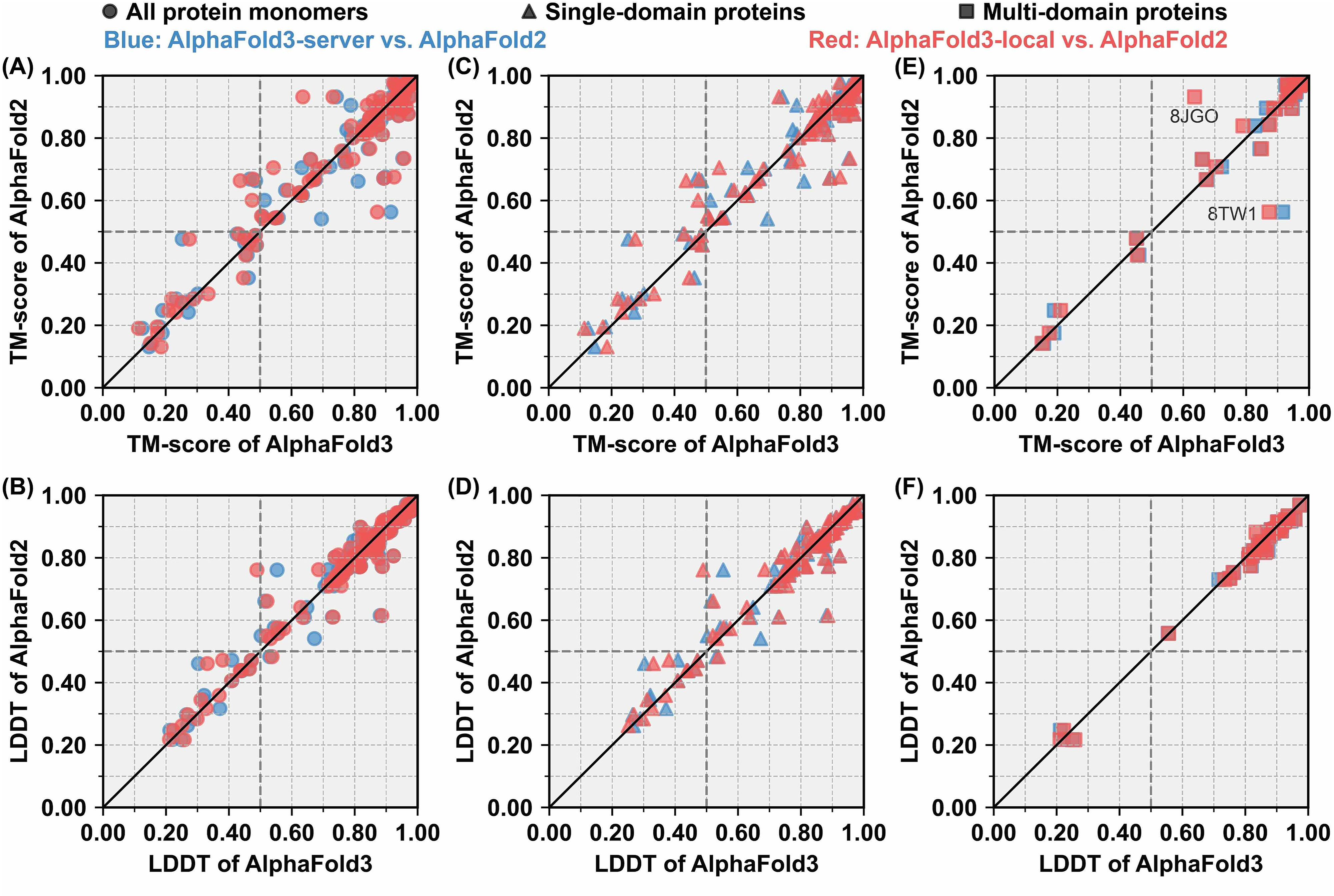
Below the diagonal favors AF3. Global-fold gains are less consistent.
What if homolog information is missing?
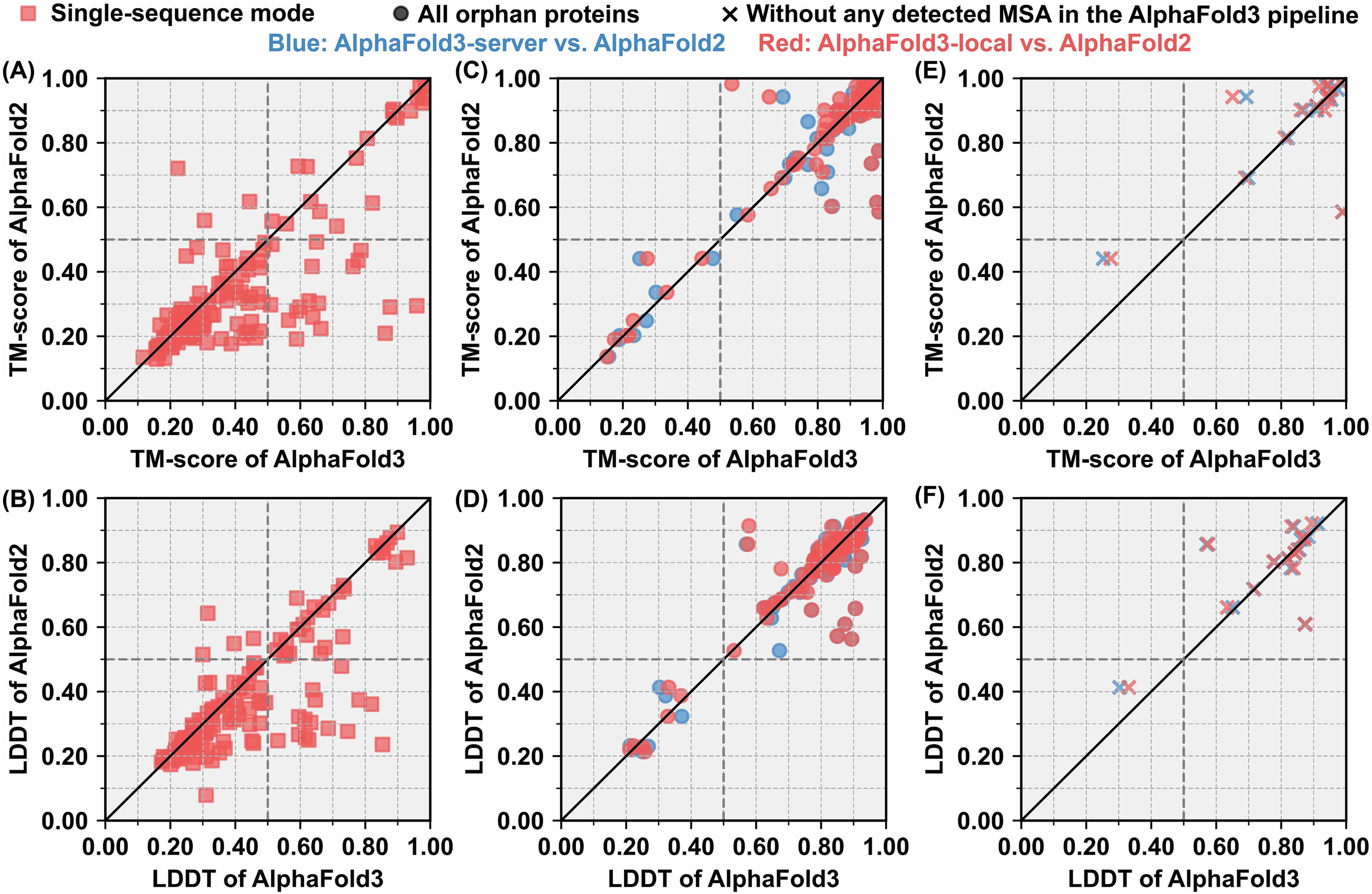
AF3 improves forced single-sequence prediction, but both models struggle.
ESM: a language model for proteins
ESM = Evolutionary Scale Modeling. ESM-2 learns to predict masked amino acids.
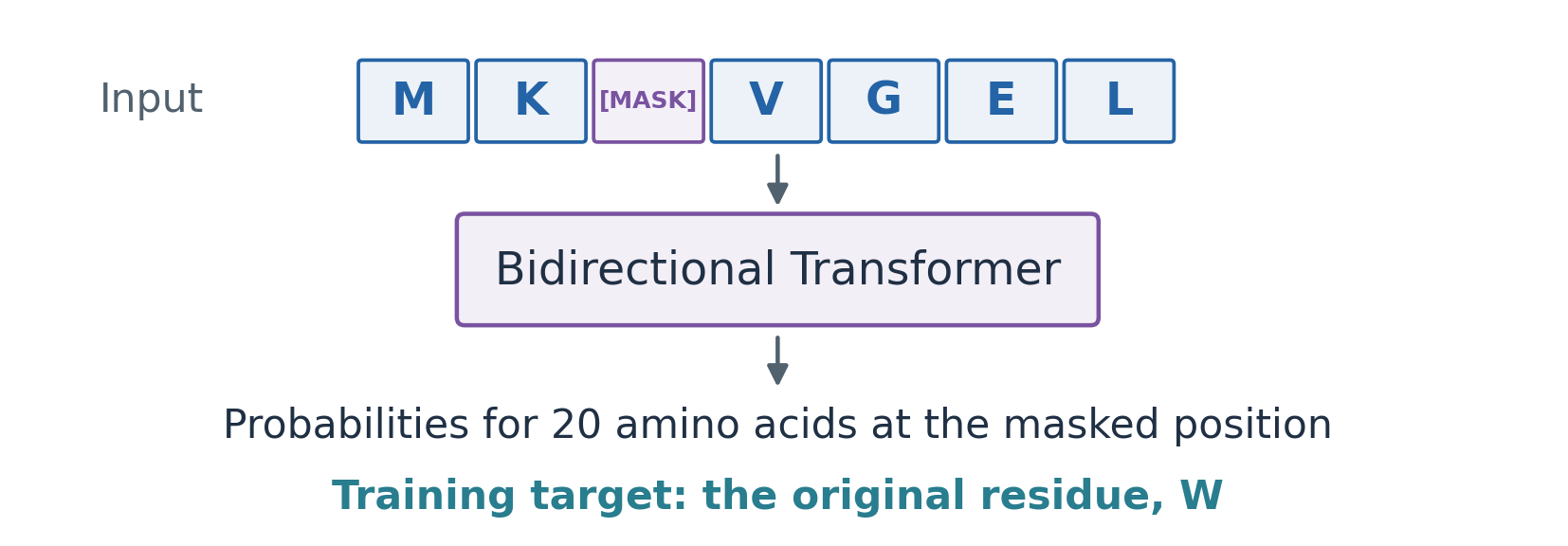
- Amino acids are tokens; self-attention uses context across the sequence.
- Train on many unaligned sequences, using the original residues as labels.
- Trained on 65 million unique protein sequences (ESM2)
ESM learns more than residue probabilities
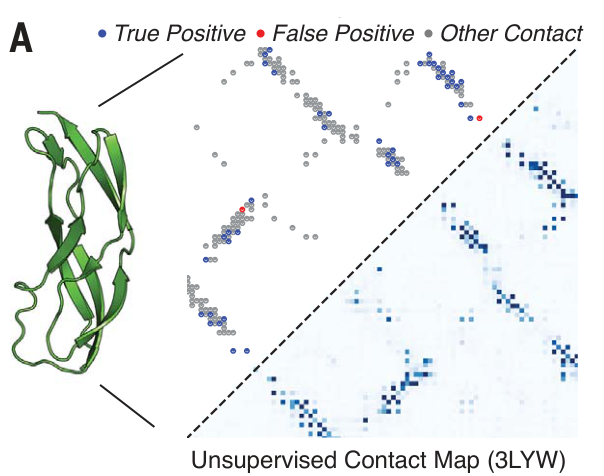
Residue embeddings: learned vectors that depend on sequence context.
Structural signal: contact information can be read out from attention patterns.
The language model was pretrained using sequence labels.
Contacts predicted from attention weights of ESM model.
ESMFold: turn representations into structure

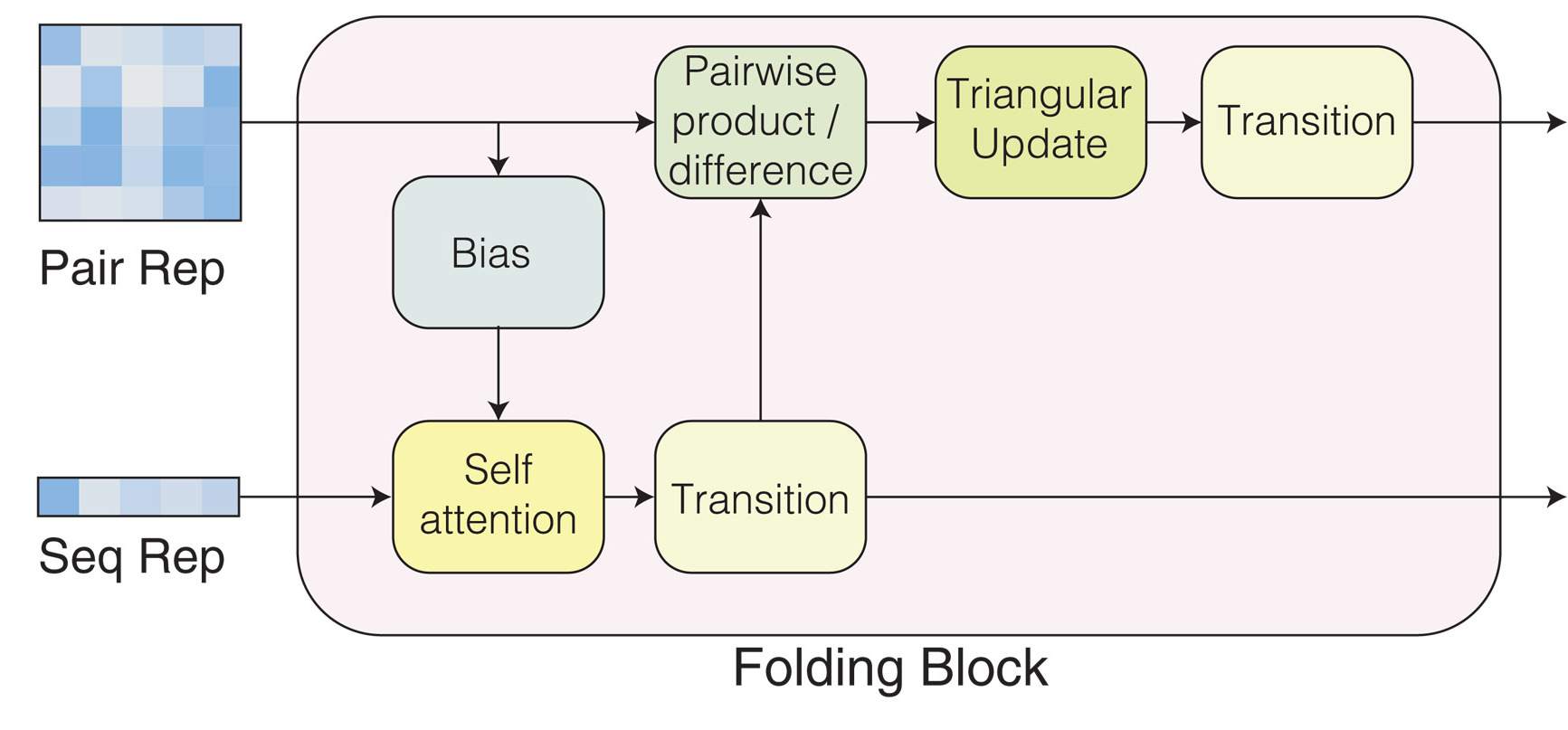
ESM-2 representations → supervised folding head → atomic coordinates.
The folding head learns from experimental and AF2-predicted structures.
Inference uses the target sequence without an MSA search.
ESM Folding Block
Performance
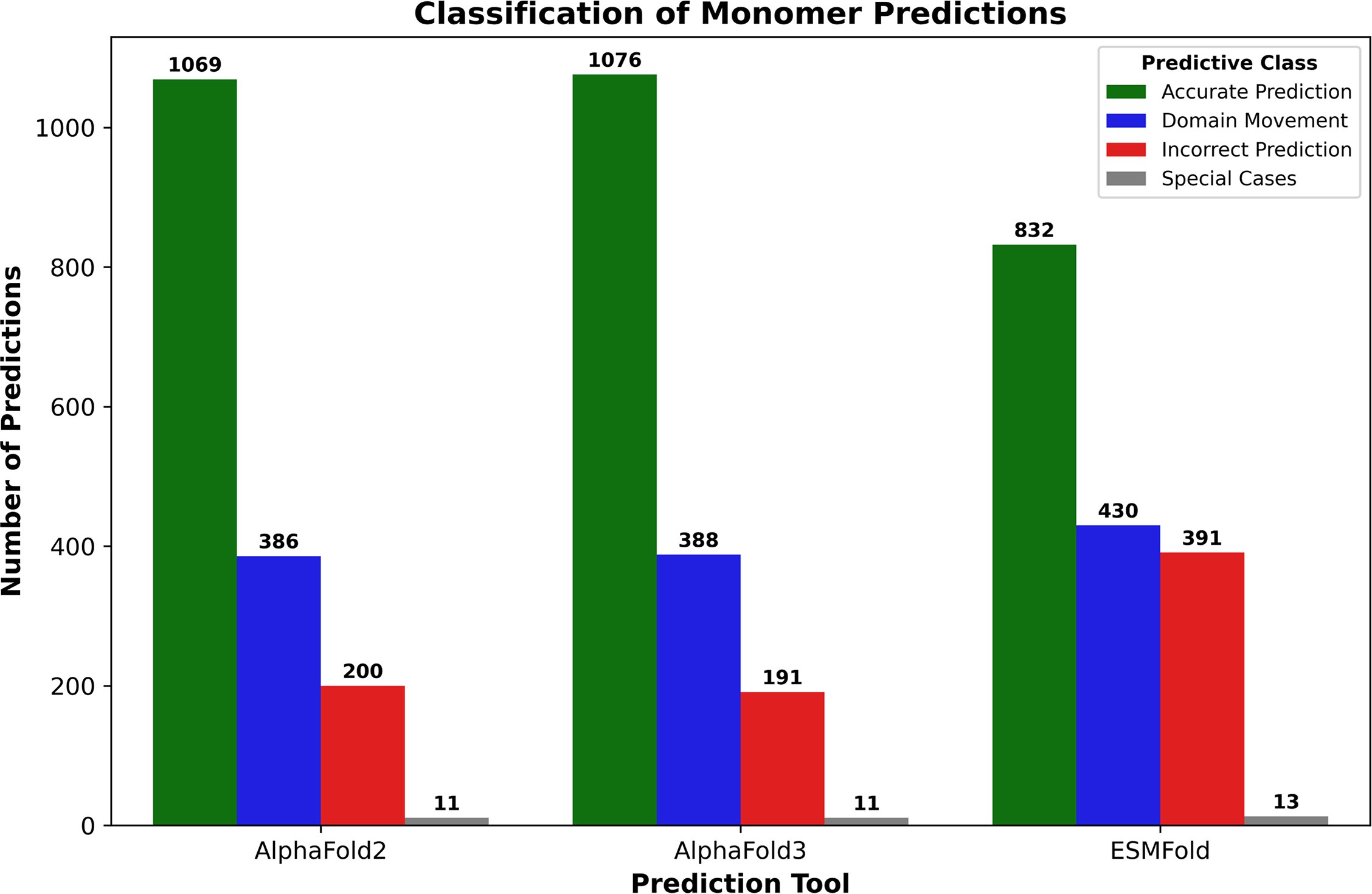
Mahtha, Venkadesan & Mohanty (2026). Comparative evaluation of the prediction accuracy of AlphaFold and ESMFold for monomeric and dimeric proteins. NAR Genomics and Bioinformatics 8(1), lqag002.
RoseTTAFold: couple three tracks

Exchange sequence, pair, and 3D information throughout the network.
RoseTTAFold All-Atom: broaden the chemistry

Add atom–bond graphs and chirality to model mixed molecular assemblies.
One timeline: expanding the prediction task
| Milestone | What changed? |
|---|---|
| 2020–21: AF2, RoseTTAFold | Accurate monomer structures; joint geometric reasoning |
| 2021: AF-Multimer | Train explicitly on complexes |
| 2022–23: ESMFold | Language-model features support single-sequence prediction |
| 2024: AF3, RFAA, Chai-1, Boltz-1 | Broader molecular composition |
| 2025: Boltz-2 | Structure prediction plus an affinity component |
Structure Prediction $\ne$ Protein Folding

Many proteins fold in vitro ... but it can get complicated
Molecular chaperones are a group of unrelated protein families whose roles include preventing protein aggregation, assisting in correct folding and assembly of proteins, or disassembling complexes or aggregates.
Chaperone Example: Heat Shock Protein 70

Chaperone Example: Heat Shock Protein 70

v= py3Dmol.view('1dkx',style='cartoon:color~magenta'); v.setStyle({'chain':'B'},{'stick':{'colorscheme':'whiteCarbon'}}); v.setStyle({'chain':'A','resi':'1-507'},{'cartoon':{'color':'lightgreen'}});v.zoomTo({'chain':'B'}); v.show()
3Dmol.js failed to load for some reason. Please check your browser console for error messages.
Chaperones as Drug Targets
Extremely challenging
Cancer: increased mutation burden and protein expression in cancer cells mean they are more dependent on chaperones for proper protein folding
- Targeting heat shock proteins induces degradation of mutated proteins
- Inhibitors commonly bind to ATP binding pocket
- Toxicity issues
Neurodegenerative Diseases: Alzheimer’s, Parkinson’s, and Huntington’s disease all involve misfolded protein aggregates.
- Upregulating chaperones may reduce aggregation (Arimoclomol - Niemann–Pick disease)
Takeaways
- Multimer: joint prediction needs interface-specific assessment.
- Sampling: recovering states is different from predicting populations.
- AF3: molecular conditioning + atomic denoising expands the scope.
- ESMFold: sequence pretraining changes what is needed at inference.
Choose the model and validation for the biological question.