DUE: 11:59 PM MONDAY, NOVEMBER 30
In this assignment, you will identify a small molecule that binds to NRAS Q61R and blocks its signaling.
Your two objectives are:
- Efficacy — Your compound should interfere with NRAS signaling. There are a number of options for achieving this:
- Competitively inhibit a key protein-protein interaction (e.g., from the last assignment). This approach has the benefit that you can use the interactions from the PPI to design your compound.
- Prevent GTP binding (but not GDP)
- Stabilize the inactive conformation of NRAS
- Selectivity — Your compound should prefer binding to Q61R over WT. You can achieve this by:
- Directly interacting with R61
- Binding to an NRAS conformation that has a lower free energy for Q61R than for WT
Target Structure Selection
Using the data from the previous assignments, select an NRAS structure and putative binding site for your compound to target to meet the above objectives.
Pharmacophore Elucidation
Design a pharmacophore for your identified binding pocket. You may use any tool that is available to you: fragment docking with gnina, PharmacoForge, FTMap, CavPharmer in CavityPlus, or simply by inspection. You are encouraged to try multiple approaches and integrate all the results. Recall that hydrophobicity drives potency, but hydrogen bonds favor selectivity (and water molecules really do not like being buried inside a protein). Developing your final pharmacophore should be an iterative process. You want a query that is reasonably selective (<50,000 hits) but not overly so (>100 hits).
Screening
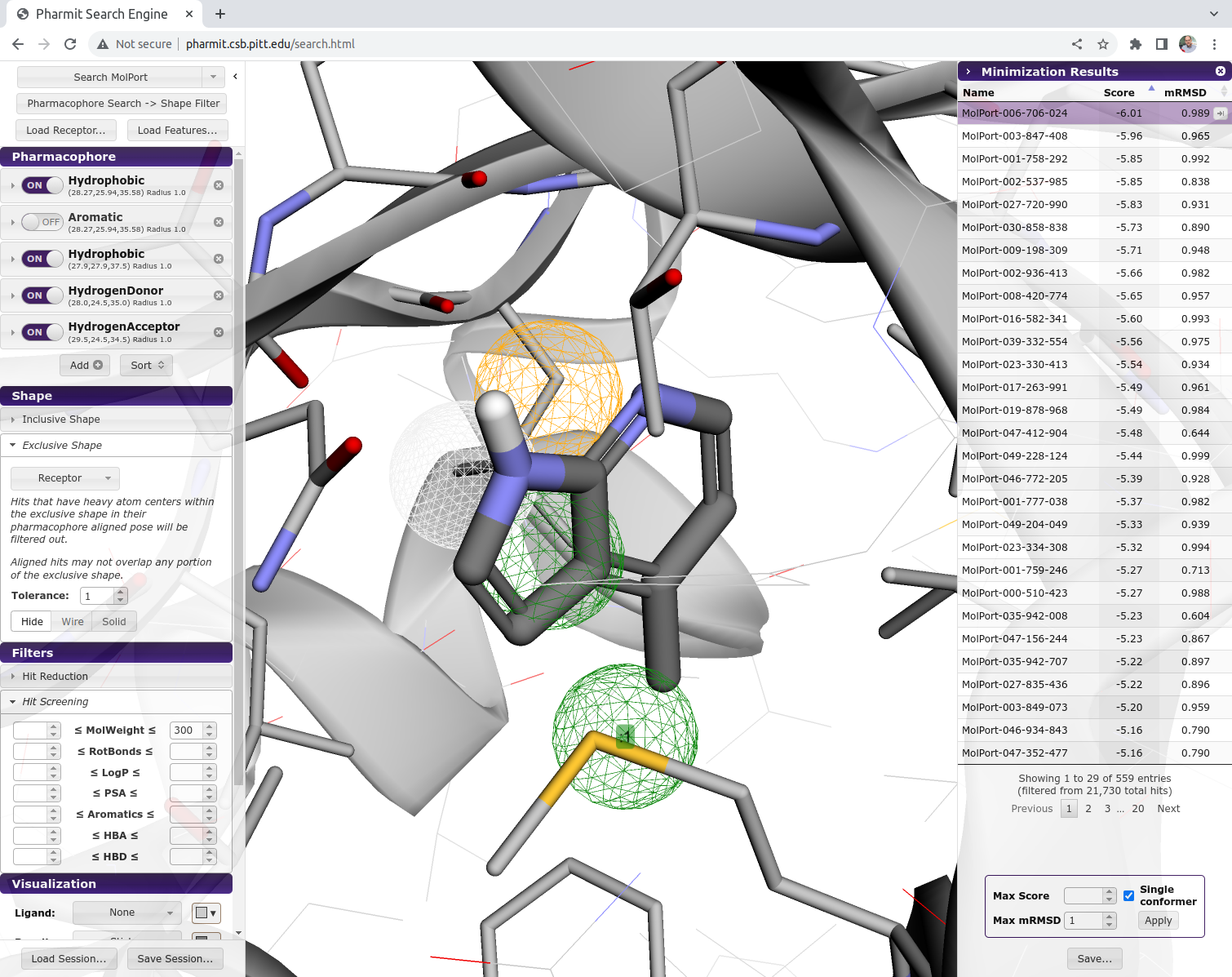
Create your pharmacophore in Pharmit and screen for matching compounds. You should modify your query based on the result (e.g., add features and filters to make the query more selective or remove them to make it less selective). You should screen multiple databases in your search for the best possible molecule. You should save both the query (Save Session) and final results (Save).
Minimize the results of your Pharmit query using GNINA:
gnina -r rec.pdb -l query_results.sdf --minimize -o min.sdf.gz
Select a single "best" compound for further evaluation. Your selection criteria may be as simple as the best score (e.g., highest CNN_VS, which is the product of CNNscore - pose quality and CNNaffinity - predicted affinity) or may be a consensus criterion that combines scores or incorporates your insight into the molecular interactions present. You may also apply other tools (such as Boltz's binding affinity prediction) to help rank and select your top molecule.
For full credit, your selected compound should have a Vina score (minimizedAffinity) < -6 kcal/mol and a CNN_VS > 2 (achieving this should not be difficult). You will submit your best compound along with its corresponding receptor structure to a GradeScope leaderboard for evaluation (this is a separate assignment section due to GradeScope requirements).
You should submit a 1-2 page report describing your approach and results (you may include a third page of supplemental figures if you wish). You should clearly specify your rationale for selection of target structure, binding site, and interactions and explain why these choices could plausibly result in an effective and selective compound. In your results section, you should provide evidence that your selected compound(s) might achieve the desired objectives (there should be visual representations of the compound mechanism of action).
Submitting to the leaderboard is worth 20 points.
You need to upload a decently scoring ligand for full credit (minimizedAffinity < -6 and CNN_VS > 2). You should upload your receptor structure as a PDB file and the ligand as an SDF file. You select the receptor structure — it may or may not contain GDP, or it may be refined specifically for ligand binding (e.g., run an MD simulation with the ligand to get the best possible binding mode). Molecules are scored using GNINA 1.3.
If your receptor structure is not NRAS Q61R you will receive zero credit. While your receptor structure does not have to have GDP bound, it remains a requirement of the assignment that your ligand not disrupt GDP binding (e.g., uploading GDP/GTP as your ligand for the leaderboard will receive no credit).